For organisations seeking to base decisions on clear data-driven findings, access to uniform and organised customer data is a crucial first step.
However, when it comes to address data, such a project can easily fall at the first hurdle. Inconsistent and inaccurate addresses make it hard to understand which customers are buying from which locations, and a lack of geographic information means data teams cannot plot address data spatially.
In this article, we’ll look at some of the common causes of this issue, and explain how you can turn your existing records into clear, correctly-formatted, and accurate addresses.
Why is address data so inaccurate and inconsistent?
An address can be challenging to standardise and verify, particularly when customers and staff are inputting them manually. Many addresses will be simply inaccurate or missing vital delivery information. In fact, our research has found that up to 2.5% of manually entered addresses may be completely undeliverable.
Of course, many addresses may be deliverable but still missing useful information. In Ireland, this could be an address entered without an Eircode, or one missing a field of the townland or city.
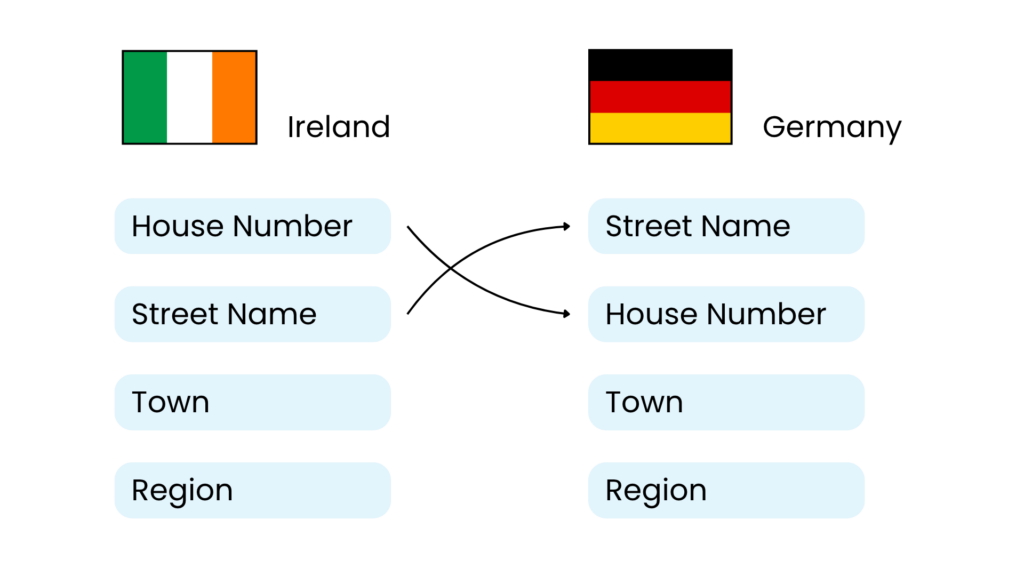
In other cases, customers will abbreviate elements of their address when writing it. For instance they may use “st” as a replacement for “street” or “crt” as a replacement for “court”. And even when each element is correct, the order they are written in can differ. This is particularly true for international deliveries, as different countries write the house number, street, and area in different orders.
How to cleanse inaccurate and inconsistent address data
Address cleansing is the process of taking the records you already hold and bringing each one up to a consistent, verified standard. Rather than asking customers to re-enter their details, it works on the data as it stands, which makes it the practical option for a database built up over many years and from many sources.
How cleansing works
A cleanse runs in three stages, and each depends on the one before it.
The first stage is parsing. Each address is broken into its component parts, such as the building number, street, townland, town, county, and Eircode or postcode. This is where single-field addresses are separated out, and where ambiguous entries such as “Flat 2 14 Main St” are resolved into the correct building and sub-building.
The second stage is standardising. Once the components are known, they are brought into a single consistent form. Abbreviations such as “st” and “crt” are expanded, case and punctuation are corrected, and the elements are placed in the order expected for that country. The standard applied is the postal authority’s own, so that Irish addresses follow the Eircode address file and UK addresses follow Royal Mail’s Postcode Address File.
The third stage is matching. Each standardised record is compared against the authoritative postal data to confirm that it describes a real, deliverable address. Where it does, the record is linked to that address and inherits its correct form and its unique identifier. Where it does not, the record is flagged with a match level, so that near-misses can be reviewed rather than discarded. Matching also reveals duplicates, since two records that resolve to the same unique address are the same customer however differently they were typed.
Address enrichment
Once a record has been matched, it can be enriched with information that the postal file or a geospatial source holds about that address. For Irish data this most often means appending a missing Eircode, which turns a non-unique townland address into one that identifies a single property. It can also mean adding geographic co-ordinates, so that data teams can plot customers spatially, plan routes, or feed location into a risk model. Other enrichments include administrative boundaries, such as a local authority or constituency, and for US data the ZIP+4 extension.
Autoaddress Address Cleanse
When Autoaddress cleanse addresses, our team takes the data in whatever shape it is held, with no pre-formatting required, and runs it through parsing, standardising, matching, and enrichment against Eircode, Royal Mail, USPS, Ordnance Survey, and TomTom data. The cleansed output is returned in the layout your CRM or billing system expects, with the right fields in the right order, so it can be loaded without further work. You can read more about the service on our Address Cleanse page.
Correct data at the source: Address autocomplete
Whilst cleansing existing addresses can be valuable, it doesn’t resolve the issue of incorrect addresses being entered into your database. In order to ensure that only accurate and consistent addresses are collected, an address autocomplete tool provides users with a dropdown of addresses to select from. This reduces the need for future cleansing projects, and streamlines the checkout experience for each customer. It also prevents missed or delayed deliveries, saving you time and money.
Conclusion
Inaccurate and inconsistent address data is the natural outcome of years of manual entry, abbreviation, and differing formats, and may only become visible when a team tries to analyse customers by location or ship to them reliably. Cleansing resolves the records you already hold by parsing, standardising, and matching each one against authoritative postal data.
If you would like to understand what a cleanse would return for your own data, talk to our team today about our Address Cleanse solution.