The address a customer enters at the checkout might be one of the smallest details in an online order, but it’s also one of the most expensive to get wrong. If it’s incomplete or inaccurate, the parcel might be returned, re-dispatched, or refunded. If it’s too cumbersome to enter on the website, the order might not happen in the first place.
How much do failed deliveries actually cost?
We tend to think of a failed delivery as a courier problem. For retailers, it’s a margin problem, and in 2026 it’s bigger than most companies realise.
Every failed delivery costs UK retailers roughly £11, and costs the retail industry around £1.6 billion every year. While this figure covers the re-dispatch, second delivery attempt, handling and admin aspect, it doesn’t capture the full picture.
Address correction is expensive
When an address is wrong or incomplete, some carriers charge the retailer to correct it. FedEx’s address correction surcharge is around £7.70 per shipment in the UK and €9.20 in Ireland and across the euro zone. And this fee applies whether or not the correction actually results in a successful delivery. In the US, FedEx increased the same surcharge to $25.50 per correction in January this year, up from $24 in 2025.
A failed delivery also adds a time cost for the end customer. According to InPost, roughly one in three parcels fails on the first attempt, with customers spending around 2.3 hours resolving delivery problems. Every missed delivery requires a re-attempt that the retailer pays for, while the customer’s patience begins to wane.

The unseen cost
Some retailers absorb the cost of address correction themselves. This usually means having to manually check orders, chase customers and correct addresses before the items are shipped out. Ten minutes spent fixing one address is ten minutes not spent on work that actually grows the business. And across hundreds of orders, this all adds up! While correcting addresses in-house might look like the cheaper option, in terms of where time is truly spent, is it really cheaper?
Arguably the biggest cost of all is the customer who doesn’t come back. Around 70% of shoppers are unlikely to return to a retailer after a failed delivery, and given what it costs to win a customer in the first place, through display ads, discount codes, email nurture etc. that effort can unravel in minutes. And it’s not just one sale at stake, it’s every future order that a customer would have placed, as well as new business from potential recommendations.
So where do bad addresses come from?
The majority of bad address data comes from the retailer’s website itself. When there’s no address lookup at checkout, customers have to enter their details manually. This increases the likelihood of mistyping, abbreviating and omitting important information. In isolation, that might just be untidy data, but the real issue is when those errors come face to face with things like non-unique addresses and multi-residence buildings.
In Ireland, roughly one-third of addresses are non-unique, meaning they have no house name or number to tell them apart from their neighbours. A townland and a county can point to a cluster of houses rather than one front door. This is precisely why Eircodes matter. Unlike UK postcodes that cover a group of properties, an Eircode identifies one single address, and couriers are becoming increasingly reliant on them for successful deliveries.
In 2023, DHL Express made Eircodes mandatory on shipments into the Republic of Ireland. And in early 2026, FedEx and eCourier announced that all shipments to and from Ireland would also require a valid Eircode, with FedEx confirming labels would no longer be created without one. But without validating addresses against Eircodes as the customer types, problems can arise. Eircodes can still be entered incorrectly if they are captured manually.
Apartments and multi-residence buildings also cause problems with address accuracy, but not because of the location. Where a retailer has implemented a generic address autocomplete tool such as Google, it resolves addresses to building or street level and stops there. While it might find the apartment block, it can’t pinpoint the specific flat or unit inside it. So the parcel will reach a front door that might serve 50 homes, and someone still has to work out which one it belongs to.
Friction at the checkout
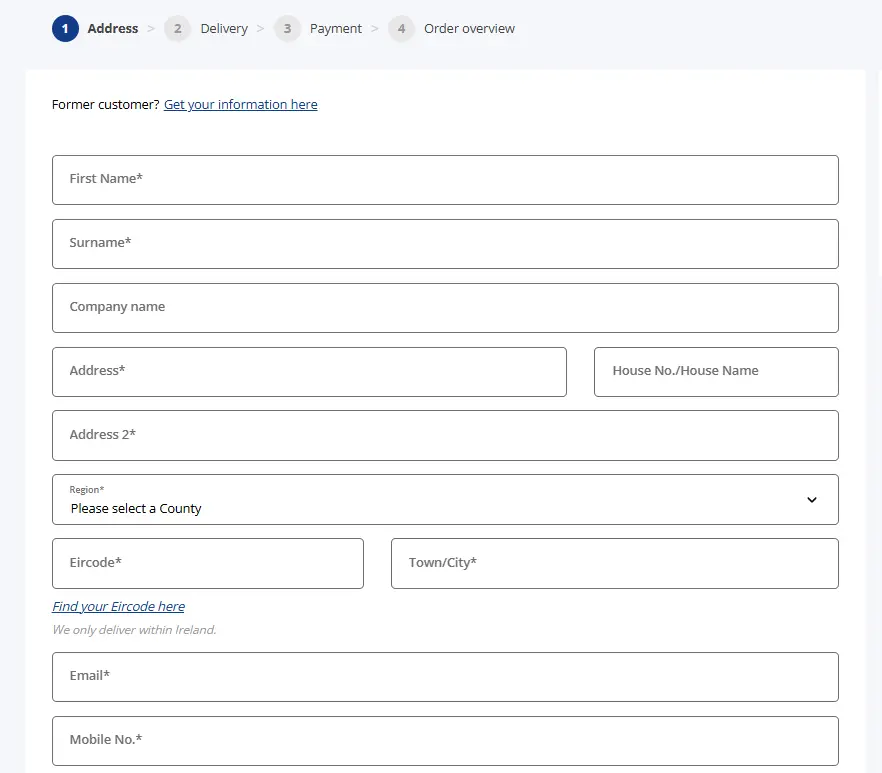
Bad data isn’t the only issue when it comes to manual address entry, it also slows down the checkout process. According to Baymard Institute, the average cart abandonment rate is 70.22%, with nearly one in five customers blaming a long or complicated checkout. Address fields are a big part of that length: the average checkout shows more than 23 form elements when the ideal flow should be 12 to 14. Unsurprisingly, the same research shows that better checkout design can lift conversion rates by as much as 35%.
Below is an example of a well-known retailer displaying 11 form fields at the checkout for just the contact and shipping information. Imagine that on mobile!
Getting the right address first time
The good news is that this is all preventable. Real-time address lookup lets a customer find their exact address in a few keystrokes, so there’s no risk of typos or incomplete postcodes. The important detail, especially in Ireland and the UK, is what “exact” means. While generic autocomplete tools stop at building level and don’t update address data on a regular basis, commercial solutions can pinpoint addresses to the exact apartment or business unit, and use the most recent authoritative data sources such as Eircode for the Republic of Ireland and Royal Mail and Ordnance Survey for the UK.
Having a robust address lookup solution at checkout also eases friction, replacing several form fields with one so the form gets shorter rather than longer. That matters most on mobile, which now accounts for around 59% of global eCommerce sales, yet converts at a lower rate than desktop: just 2.1% of mobile visits end in a purchase, vs 3.5% on desktop.
For addresses that skip the form altogether, such as those pulled from express checkouts and digital wallets, verifying each one is also critical. They bypass the checkout entirely, so a saved address that’s out of date or missing an apartment number can go straight to the fulfilment process, with nothing flagging it until the last mile.

In summary
An incorrect or incomplete address can turn into one of the biggest costs in eCommerce. From re-attempts to correction fees, hours spent manually fixing records, and customers who never come back. Almost all of it traces back to how addresses are being captured at the checkout. Manual address entry brings friction and mistakes. Generic autocomplete tools stop at the building and use out-of-date data. So it’s worth asking: how many delivery issues and abandoned carts started with an address that could have been captured easily and accurately the first time?