Search for “address corrections” on Reddit, and you’ll find a myriad of comments from exasperated retailers and customers within sub-communities for USPS, FedEx, Shopify, and Apple Maps (just to name a few).
We all know the statistics...
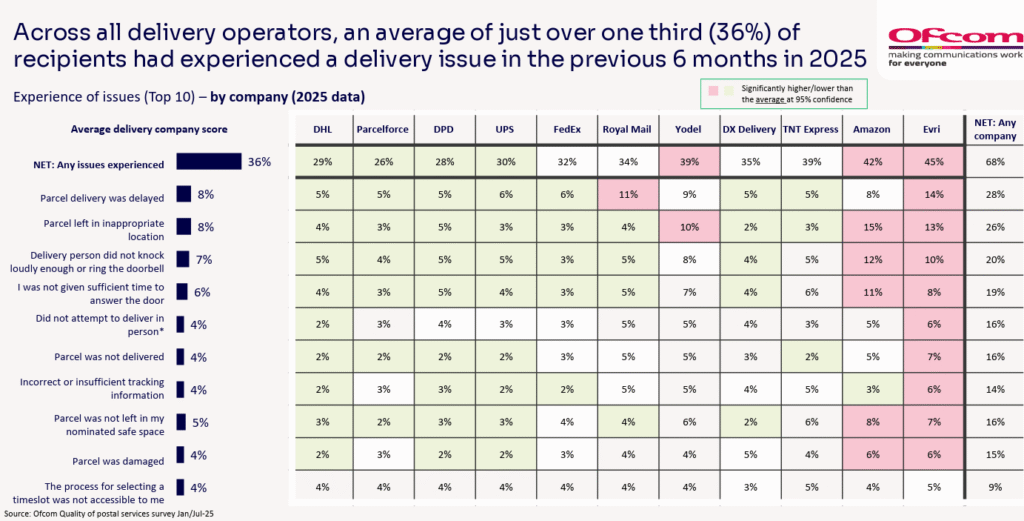
We often hear anecdotal statistics like X% of failed deliveries being caused by address errors, or X% of cart abandonment rates occurring because of unnecessary checkout friction, but we never hear what the actual retailers and end customers say about it. The information is usually buried in an eCommerce report along with plenty of other numbers and percentages. Sometimes, address data isn’t even factored into the figures. For instance, Ofcom’s 2025 tracker asked 4,058 UK recipients about parcel deliveries and found 68% had experienced at least one issue in six months, with delays occurring in 28% of cases. Address accuracy was not mentioned once throughout the report.
This isn’t an oversight, though. Ofcom surveys recipients, and somebody standing at their own front door might have no knowledge of a parcel going astray because of issues with their address. In Ireland, ComReg reported 140.73 million parcels delivered during 2023 by the seven main providers, yet no failed-delivery figure was recorded.
What the Redditors have to say
In the r/Shopify community, one merchant described receiving customer emails several times a week about wrong addresses, usually the house number or postcode, against an average of around 150 orders a week, clearly frustrated by this constant problem: “Could anything be causing this or is it just people not paying attention? It seems odd that so many people are making the same mistake.”
A second merchant reported that: “Roughly one in 30 orders incurs a $15 address correction fee because the customer forgot to include their apartment or unit number.” On the other side, a courier described the same thing from their perspective; parcels arriving with a street and a building number but no unit, taken back, relabelled and sent out again “Happens to me every single day. Nobody likes putting apt #.”

A third merchant also stated that their issues stemmed from Google autofill (Shopify’s built-in address autocomplete), with the original poster deciding to turn it off in the hopes of seeing some improvements in their address accuracy.
Speaking of Google autofill…
On Shopify’s community forum, a UK retailer mentioned “The Google autocomplete dropdown suggests the address but misses out the door number and just shows the remainder of the address. Customers unknowingly select it, then their order goes out without a door number and gets returned to us by Royal Mail.” And unfortunately, that cost lands on the retailer. “The customer complains to us and we have to resend the order out at our cost.” Another retailer based in the US complained about how Google formats addresses: “The autocomplete is a nice feature, but the addresses are not formatted correctly for carriers with proper abbreviations. This is causing problem during shipping label creation.”
Irish addresses adding another layer of complexity
As well as missing apartment numbers, Irish addresses unfortunately seem to cause even more confusion with Google’s API. One boards.ie poster mentioned: “It seems some services that make you use an Eircode auto populate the address field cut out part of the address, so it ends up being 1 Fake Street, Wrong Town, County, and the estate and village are missing.”
Another Shopify merchant based in Ireland also talked about the ambiguity of towns and cities sharing the same name as the county, and how that’s presented in the address field. e.g. Carlow, Wicklow, Tipperary, Monaghan, Cork, Galway. “When I receive an order, it lists the county in this format: Tipperary, Limerick, Dublin. I have no idea unless an Eircode is added whether we are talking about the county or a town/city. I have to look it up every time using the Eircode finder.”
It should be noted that Shopify did make the Eircode field mandatory in June 2023, so complaints about missing Eircodes should no longer be an issue. However, Shopify’s changelog about the rule is vague: “Eircodes are required on both domestic and international orders regardless of shipping method selected.”
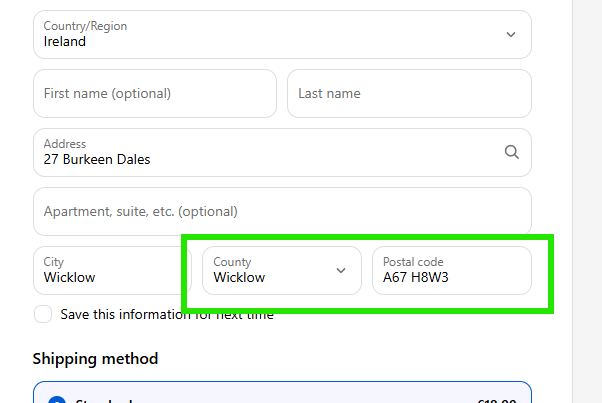
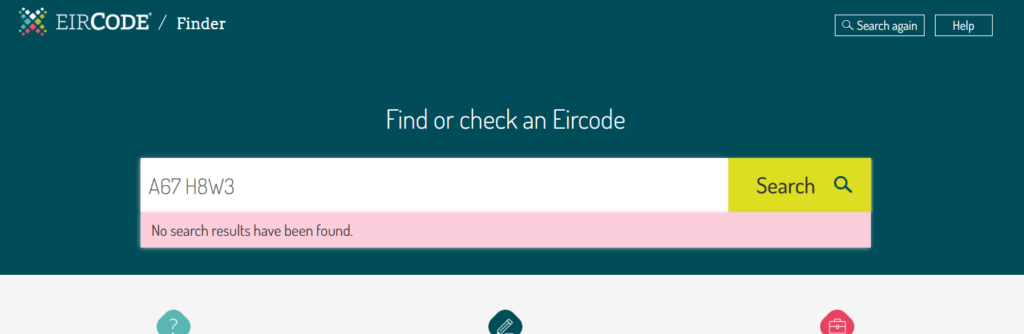
And mandatory does not mean correct. Irish shoppers still have to manually type in their Eircode to a plain text box with no lookup behind it. Shopify’s own validation only goes as far as the routing key [the first three characters that map to a particular area], but not the 4 remaining characters that are unique to every address. Therefore, it’s still possible for someone to enter an incorrect Eircode. And this is exactly what we found when we analysed a single day of 50,000 Irish address submissions.
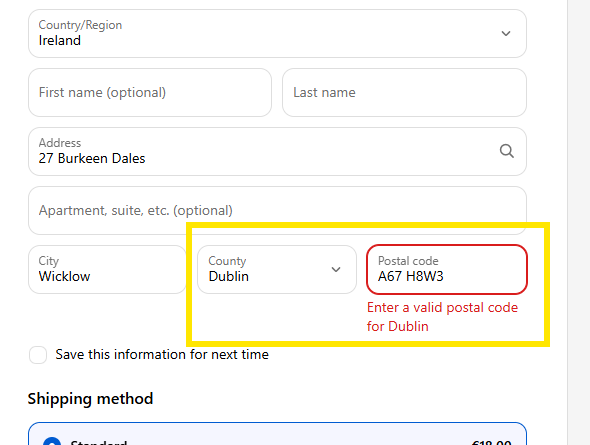
Above example demonstrates what happens when the Eircode routing key does not match the county selected. This is Shopify’s built-in validation for Irish addresses.
The above example shows the limitation of Shopify’s validation, as the Eircode entered is incorrect and does not actually exist. Yet no error is displayed to inform the customer of this, and the order will progress as normal unless there is a third party validation solution in place to catch the error.
So who's footing the address correction bill?
One retailer on Reddit noted carrier invoices of around $2,800 due to address corrections, which were working out at more than $23 each. UPS’s 2026 service guides price address correction at £10.30 per package in the UK and €11.10 per package in the Republic of Ireland. A fulfilment operator added that, while some charges are disputable, “The process is manual and takes time, and most 3PLs just pay those costs.“
A UK based Shopify merchant facing cart abandonment issues due to rejected postcodes noted the difficulty in being able to quantify the problem: “Some of them [customers] contacted us, but we might have lost a lot and not really know.” This inability to measure the true extent of the problem means the loss does not always take a monetary form. While it may sometimes manifest in address correction and re-delivery fees, it’s also a customer who was never acquired in the first place. No one can put a value on that. Those are arguably the easiest losses to overlook, and potentially the most expensive to keep repeating.
Worth citing more often
None of the quotes above came from surveys or eCommerce trend reports. They were written by retailers, couriers and customers who were trying to solve a real problem, one that was costing them money or causing frustration.
eCommerce reports tend to be built comparing one year to the next, meaning that categories are based on areas someone has thought to ask about. A problem that hasn’t been named yet won’t have its own category.
Communities like Reddit and Shopify’s own help forum are cited far less often than they deserve to be. One post is not a statistic, granted. But several merchants describing the same failure is a signal worth following, and it points to genuine pain points occurring every day.
In Summary
Ultimately, the same thing keeps happening: there is an issue with the address before the order is picked, the label printed, or the package shipped. The correction fee, the returned parcel, the support email and the lost sale all come afterwards, symptoms of the root problem.
Maybe the more pertinent question is not what the industry average is, but what support emails, forum posts and reviews would say about how many of those issues could have been avoided if the address had been correct in the first place.