
Is it time for Eircode to be a mandatory field?

Many eCommerce retailers still consider Eircodes to an optional data point on checkout forms, despite these alpha-numeric codes making up a critical component of every address. Without them, addresses are incomplete and much more likely to cause to delivery issues.
Ireland’s address structure can wreak havoc when Eircodes aren’t captured during checkout. Unlike the UK’s standardised postcode system or the US ZIP code format, Irish addresses without Eircodes can be completely ambiguous.
The one-third problem: non-unique addresses
One of the more complex challenges here regarding addresses is that roughly one-third are non-unique without an Eircode. From our own research earlier this year, we found that 12% of online orders did not include the Eircode as part of the address. Here’s why that’s problematic:
Ardoughan, Ballina, Co. Mayo.
This townland area is just one example of a postal address comprising of more than 10 properties. Each has its own distinct Eircode and this is the only way to tell them apart. Similarly, 1 Blackrock Road, Bantry, Co. Cork appears to be a unique address, but is actually made up of five different properties.
We also see this with 1 Bridge Street, Tipperary: one address for five properties, of which two are businesses. An address for 1 Bridge Street can also be found in both Clonmel and Carrick-on-Suir.
Confusion can even occur in urban areas. “15 Church Road, Dublin” could refer to an address in Dublin 3, Dublin 13, Dublin 15, or South County Dublin.
Local boundary divisions can also cause issues. These two addresses in Co. Wexford are actually in different areas, despite being next-door neighbours.

This lack of specificity can add real cost to businesses in the form of:
– Failed or late deliveries resulting in financial costs: it’s reported that the average cost of failed deliveries in Europe is €14 per parcel
– Extra manual work by fulfilment and customer service teams correcting errors
– Poor customer experiences which can negatively impact the brand
In a landscape as unique as Ireland’s, it’s clear that Eircodes bring clarity and certainty to our address system needs.
Other industries are already relying on Eircode
While eCommerce retailers debate on whether to make Eircode
a required field, other industries have already made it a non-negotiable part
of their service model. As noted on the 10th anniversary, Eircodes provide the
foundational infrastructure needed for reliable service and accurate delivery
in Ireland across multiple sectors:
1. Emergency services and first response
Ireland’s emergency services rely on Eircode to accurately locate incidents in both urban and rural areas. This level of accuracy has become so trusted that many emergency call systems now prompt for Eircode as part of the initial triage process. See examples below of various social media posts emphasising the importance of Eircodes:

2. Utility companies
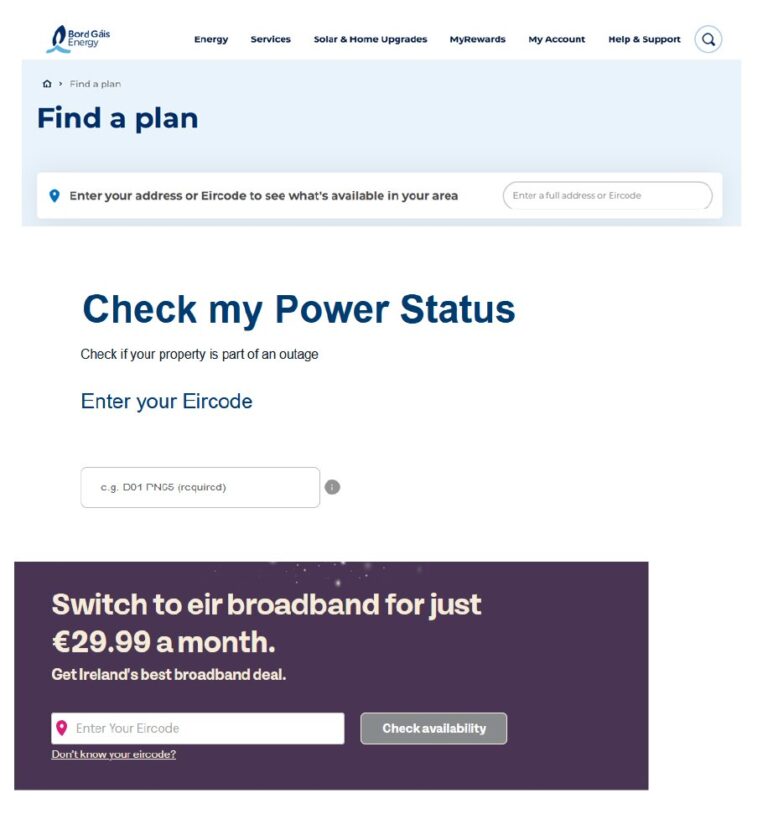
Utility companies were among the first to adopt Eircodes at scale, recognising the need for precise location data. It enables confident asset mapping, and efficient route planning, and is fully embedded in systems across the sector. See examples below from power outage checking to broadband and gas/electricity installation:
3. Local & national government
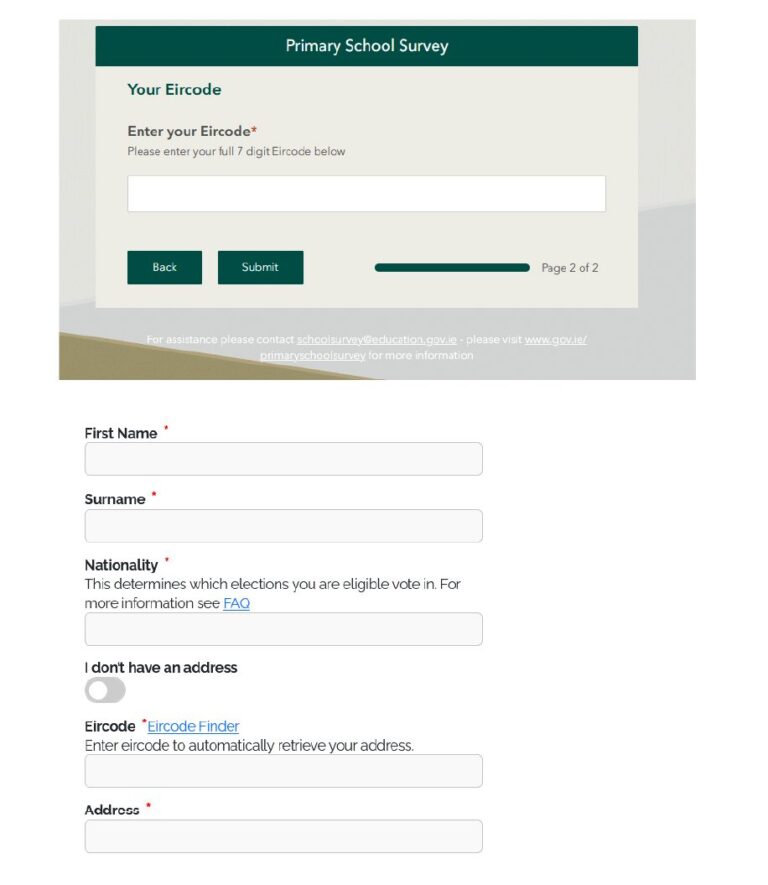
Eircodes are also ingrained in the operations of national departments and local councils, from verifying household locations for grant eligibility, to determining school transport eligibility and birth registrations.
4. Food ordering
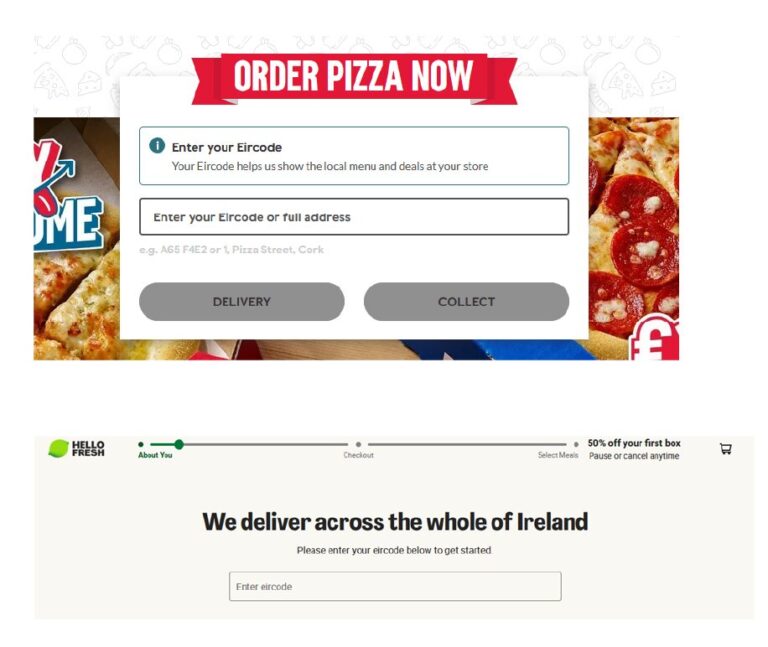
Food delivery apps are one of the most visible examples of mandatory Eircode implementation to ensure accurate routing. Delivery zones are defined by Eircode boundaries and optimised using drive-time data. See examples below from Domino’s and HelloFresh.
Removing the friction
We understand the concern: won’t insisting that Eircodes are mandatory just add friction at checkout? Not necessarily. In fact, with smart form design, address entry can become faster, easier, and far more accurate (especially on mobile, where good UX really matters).
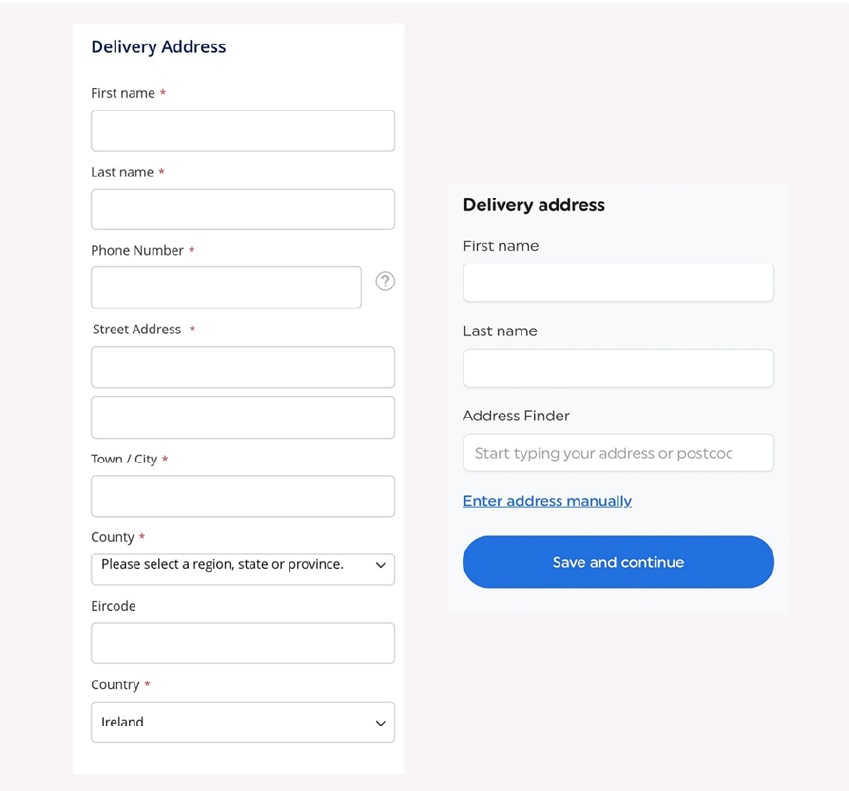
Placing the Eircode field first allows the rest of the address to autofill instantly, reducing the effort for the user. One-line address fields combined with API lookups and real-time validation help catch mistakes early and guide users gently to the right format. These features reduce keystrokes, not increase them.
The goal isn’t to make the form longer, it’s to make the form smarter. A smarter form catches errors before they lead to delivery problems, customer complaints, or manual rework.
See the mobile difference between two checkout experiences: one with six fields and an optional Eircode, and another with a single smart input powered by an address lookup API. For ambiguous addresses like our Ardoughan, Ballina, Co. Mayo example, the standard form leaves room for error when the Eircode isn’t required.
Testing the waters
Making Eircodes mandatory doesn’t have to be all-or-nothing. A phased rollout allows time to test, measure, and iterate; minimising risk while building a case for broader adoption. Here are some considerations:
- Start with new customers: make Eircode entry a requirement for account creation or guest checkout, while returning users can update their saved address over time.
- Use progressive validation: during early stages of rollout, gently prompt users with messages like: “Adding your Eircode helps us deliver faster and more accurately” rather than triggering errors straight away.
A/B test variations to find the best-performing implementation:
– Mandatory vs optional fields
– Early vs late placement in the form
– Manual entry vs smart autofill
The data will quickly reveal whether completion rates are impacted and if delivery performance improves. In fact, making Eircodes mandatory might actually boost conversions by reducing friction, speeding up fulfilment, and delivering a smoother, more reliable checkout experience for customers.
Conclusion: time to catch up?
Other sectors have already embraced the value, reliability, and ROI of Eircodes. From emergency services to everyday consumer apps, the message is consistent: capturing Eircodes improves delivery accuracy and meets customer expectations shaped by over a decade of adoption.
Getting it right the first time means fewer delays, fewer customer queries, and fewer manual workarounds. Beyond reducing issues, it helps create a smoother, more reliable experience for everyone involved.
So maybe the real question isn’t whether to make Eircode mandatory, rather, how much is it costing not to?