We know that Irish addressing is unique; between townlands, dual-language place names, local naming conventions, and multiple accepted address formats, Irish addressing doesn’t always fit neatly into the rigid structures that many systems expect. That’s especially true when it comes to addresses written as Gaeilge (in Irish).
At Autoaddress, supporting Irish language addressing has always been part of how our platform works. As an Irish company specialising in address intelligence, we designed our search technology around how people in Ireland actually write, search for, and use addresses, in both English and Irish.
Do all addresses exist in both English and Irish?
The short answer is no. While we do have English and Irish versions of every address from the source provider, An Post, some address elements—such as organisation names and house names—are not provided in both languages; instead, the same text is used in both English and Irish.
What is a Gaeltacht area?
Gaeltacht areas are regions of Ireland where Irish (Gaeilge) is recognised as the primary community language. These areas are primarily located along the west coast, including parts of Donegal, Mayo, Galway, Kerry, Cork, but also Meath, and Waterford.
Within Gaeltacht areas:
- Residents use the Irish language in everyday life
- Irish-language placenames are officially recognised
- English placenames may not have official legal status
- Public bodies are often required to support Irish-language communication and addressing
There are approximately 57,000 buildings located within Gaeltacht areas in Ireland.
For many organisations, particularly public sector bodies, utilities, healthcare providers, logistics operators, and ecommerce platforms, correctly supporting these addresses is increasingly important.
How does Eircode source data model Irish Language addresses?
One of the more sophisticated aspects of the Eircode Address Database (ECAD) is that it was designed as a bilingual address model from the beginning. ECAD stores English and Irish address elements side-by-side throughout the database. Each address component contains:
- an English field (
NAME) - an Irish field (
NAME_IRISH) - an
IRISH_VERIFICATION_IDindicating the quality and legal status of the Irish-language version
The Irish Verification flag can be one of the following:
| Validation Level | Meaning |
| 0 | No Irish — English used |
| 1 | Eircode-generated translation |
| 2 | Unofficial translation |
| 3 | Official Irish-language version |
| 4 | Legal official Irish-language version |
Official Irish placenames are sourced from the Placenames Branch and published via logainm.ie
How does Autoaddress handle Irish language addresses?
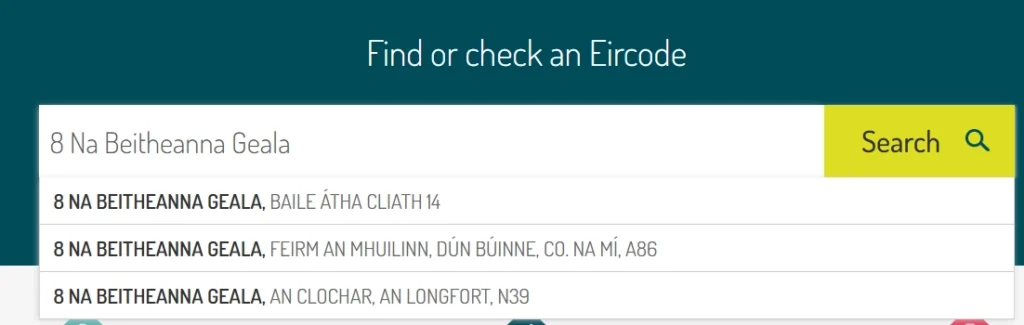
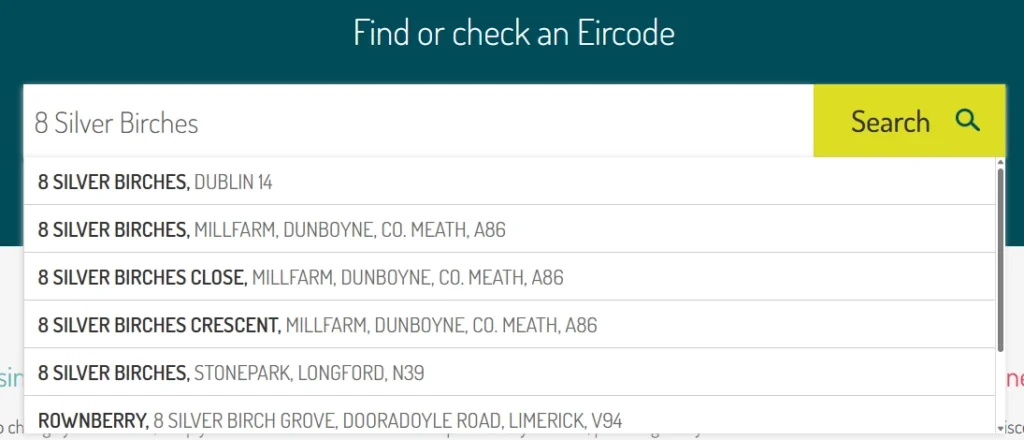
In our Capture product that provides address autocomplete, when someone starts typing an address, capture searches both the Irish and English address datasets simultaneously.
In some cases, both language variants may match the search. In others, only one version will match depending on what the customer types. If the same address is returned in both English and Irish, Autoaddress determines which version of the address to display based on the customer’s language settings and configuration rules.
This helps avoid situations where:
- Irish addresses can’t be found because the system is only searching English
- English addresses disappear when Irish is enabled
- Customers need to manually switch language settings before searching
Instead, users can simply type the address the way they know it. See below example of how we implemented this on the Eircode Finder website:
Browser and website language settings
Autoaddress can use browser language settings, website language preferences, or customer-defined language rules to decide which version of an address should be displayed to the user.
For example:
- An Irish-language website may choose to display Irish addresses by default
- An English-language website may display the English version
- If a customer begins typing in Irish, the Irish address can still be found immediately
The search itself remains bilingual.
Supporting Gaeltacht addresses
There are approximately 57,000 buildings located within Gaeltacht areas across Ireland. Supporting these addresses is particularly important for public sector organisations and services operating across both Irish and English language environments.
Addresses located within Gaeltacht areas can be identified using dedicated metadata within the Autoaddress dataset. This allows organisations to apply Irish-language display rules where required. For example, they may choose to:
- Display Gaeltacht addresses in Irish by default, and never display the English version of the address
- Retain bilingual search functionality
- Apply different display rules based on their own requirements
The underlying address remains linked regardless of which language variant is displayed.
Fadas, special characters, and technical issues
Irish includes accented vowels known as fadas:
- á
- é
- í
- ó
- ú
These are not optional decorative characters. They can change both pronunciation and meaning.
For example:
- “Seán” and “Sean” are different words
- “Baile” and “Báile” are different spellings
Historically, many international systems stripped accents or failed to support Unicode properly, causing Irish addresses to become corrupted or unsearchable.
Modern address systems need to handle:
- Unicode character support
- accent-insensitive searching
- correct display rendering
- keyboard variations
- mixed-language input
- legacy datasets without fadas
Autoaddress supports:
- full Unicode storage and display
- searching with or without fadas
- matching across Irish and English variants
- tolerant search behaviour for real-world user input
This means users can successfully find addresses whether they type:
- “Baile Átha Cliath”
- “Baile Atha Cliath”
- “Dublin”
Government regulations and Irish language compliance
Public sector organisations have significant obligations under the Official Languages Act 2003 and related regulations.
In practice, this increasingly means:
- supporting official Irish placenames
- allowing customers to use Irish-language addresses
- correctly displaying Gaeltacht addresses
- avoiding forced anglicisation of placenames
Many government tenders and public procurement processes now include Irish-language and accessibility requirements for digital services.
