If you’ve never heard of Small Areas, you’re not alone. Despite being one of Ireland’s most useful geographic datasets, they remain largely unknown outside of specialist circles. The name doesn’t help. “Small Areas” sounds generic, almost throwaway. But the data underneath that unremarkable label is anything but.
Small Areas are the finest-grained geographic unit in Ireland at which Census data is published. They carry rich, detailed information about where people actually live, and for businesses that deal in insurance, retail, telecoms, logistics, or any kind of spatial analysis, that’s a significant advantage.
What are Small Areas?
Small Areas were created for the 2011 Census by the National Institute of Regional and Spatial Analysis (NIRSA) at NUI Maynooth, in partnership with Ordnance Survey Ireland. Before 2011, the smallest unit at which Census data was released in Ireland was the Electoral District, of which there are approximately 3,400. While useful, it was not granular enough for any detailed analysis.
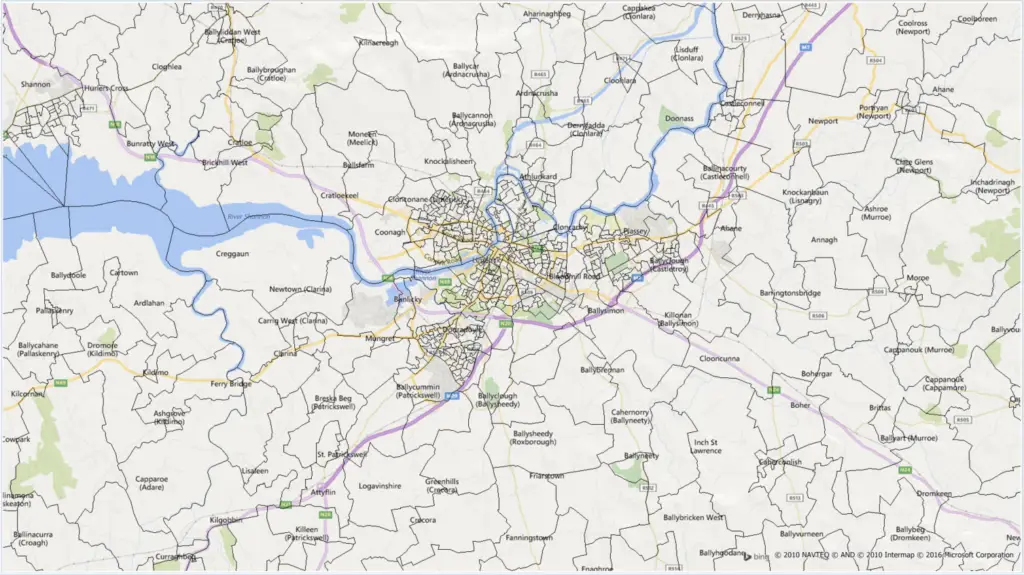
Small Areas changed that. They are carefully drawn geographic units, each typically containing between 50 and 200 dwellings. Crucially, they respect natural and man-made boundaries: roads, rivers, and other features that affect how people actually move and live. Properties within a Small Area are accessible and relatively homogeneous: a meaningful unit, not just an arbitrary place on a map.
For the 2022 Census, the dataset was revised and expanded by the CSO in partnership with Tailte Éireann (formerly Ordnance Survey Ireland). There are now 18,919 Small Areas across Ireland, a 3% increase from 18,400 in 2011. Boundaries were redrawn since 2016 to reflect population changes and to maintain consistency in size and data protection standards.
Small Area boundaries are freely available to download from Ireland’s Open Data portal, data.gov.ie.
Why Small Areas matter for business
The use cases for Small Areas span a surprisingly wide range of industries. The common thread is that they allow businesses to analyse, segment, and act at a level of geographic precision that larger administrative units (counties, local authorities, electoral districts) simply can’t provide.
Profiling and market penetration
By mapping your customer base to Small Areas, you can identify strong & weak penetration points, and Census data can provide an actionable demographic picture.
Insurance and risk accumulation
Insurers use Small Areas to assess geographic risk. For example, a flood event can be analysed at Small Area level, allowing for far precise risk accumulation.
Retail and telecoms planning
Understanding where customers live & where potential customers are concentrated informs store location decisions, coverage planning, & campaign spend.
Epidemiology and public health
Small Areas have been used extensively in health research to understand the distribution of disease and the social determinants of health across Ireland
Service delivery and logistics
Organisations that deliver to households, whether physical goods or field services, use Small Areas as building blocks for defining and optimising territories.
Why grids don’t work
When businesses first think about grouping addresses geographically, a grid is often the intuitive choice. A repeating pattern of letters and numbers looks clean and systematic. The problem is that grids are indifferent to the world they’re overlaid on.
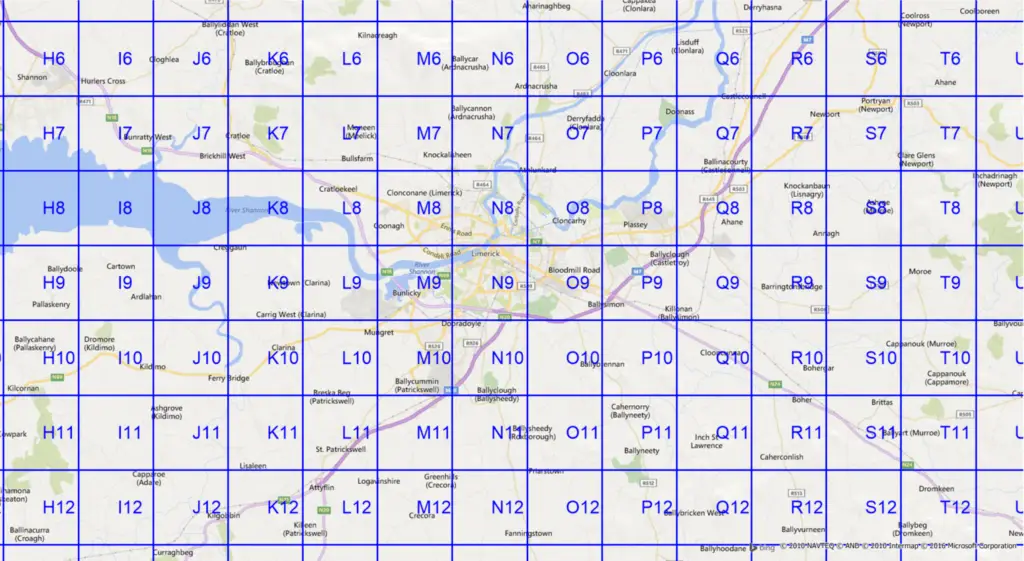
A grid square doesn’t know about the River Shannon. It doesn’t know that the properties on either side of a motorway interchange are not easily accessible from each other. It groups whatever falls within its boundary, regardless of whether those properties have anything practical in common. Use smaller grid squares and the problem doesn’t go away. You just end up with a longer, more complicated list of codes to manage.
Below is a simple grid overlaid on Co. Limerick, i.e. grid squares cut across roads, rivers, and natural boundaries without regard for accessibility.
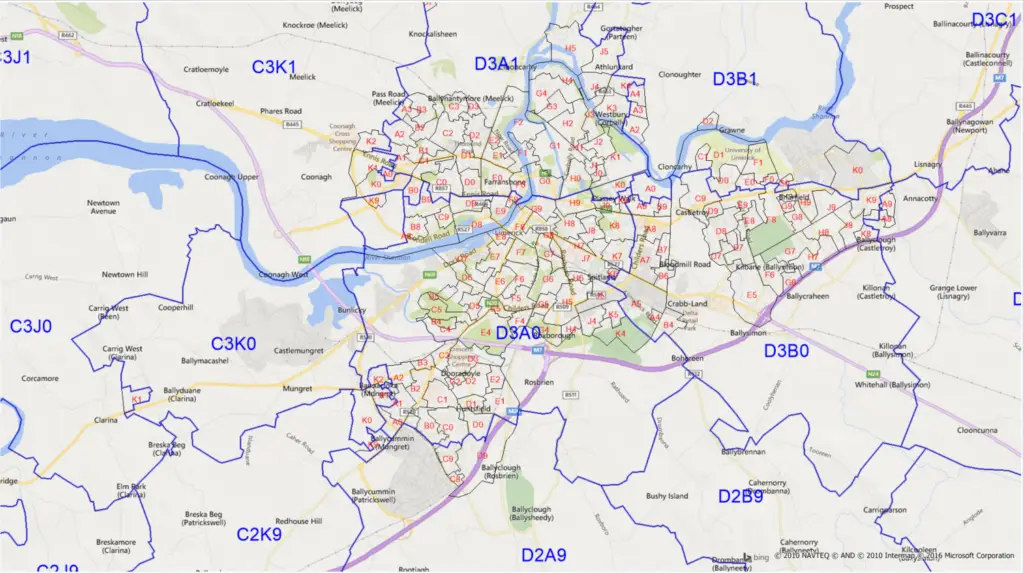
Small Areas provide far more granularity because they were drawn with accessibility and homogeneity in mind. The boundaries follow the features that actually structure how people live and move. That makes them far more useful as building blocks for any geographic analysis or operational process.
What you can build on top of Small Areas
Because Small Areas are stable, consistently sized, and respect real-world boundaries, they lend themselves to further analysis and custom labelling systems.
For example, each Small Area can be assigned a grid-based reference code from its centre point, creating a simple, sortable label that retains all the geographic intelligence of the underlying area. Using a 10×10 grid approach, four-character codes can describe rural areas of approximately 4.5km × 4.5km, while six-character codes describe urban areas of approximately 450m × 450m. Adjacent Small Areas receive adjacent codes, making it easy to group and sort them visually. This kind of approach can generate around 8,700 meaningful delivery or service codes across the country, all grounded in the geography of how Ireland actually works.
Small Areas and Eircode
The Eircode Address Database (ECAD) contains administrative codes assigned to every building using Ordnance Survey Ireland’s detailed mapping, including Small Area, Electoral District, Local Authority, and County.
The Eircode design gives something that traditional postcode systems lack: flexibility. Because Eircodes link to any boundary set rather than to arbitrary postcode polygons, you aren’t stuck with a one-size-fits-all geographic unit.
Small Areas in the Autoaddress API
Autoaddress 3.0 API, the engine behind our Capture, Verify, and Cleanse products, returns Small Area data as part of its ie_admin data setting.
For any Irish address, the API returns:
smallAreaId_2022—Small Area ID based on 2022 Census boundariessmallAreaId_2017andsmallAreaId_2015—earlier boundary versions, for organisations working with historical datasets
This means that every address captured or verified through Autoaddress can be enriched with its Small Area code.
For organisations building customer profiling systems, delivery territory tools, risk models, or spatial analytics dashboards, this is the integration point that makes Small Areas operationally practical rather than theoretically interesting.
